At First Glance, You See Bold Colors, But Look Closer
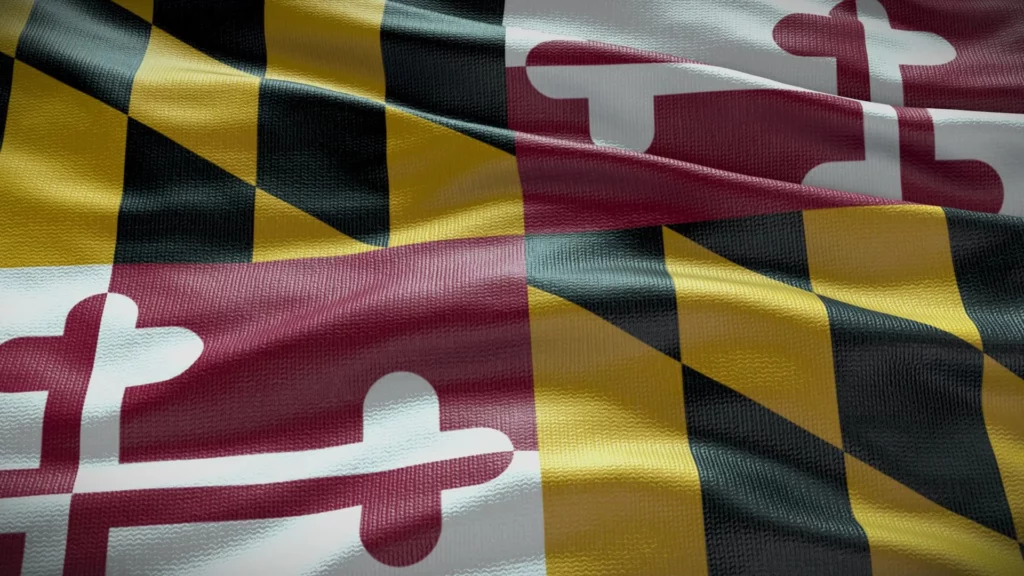
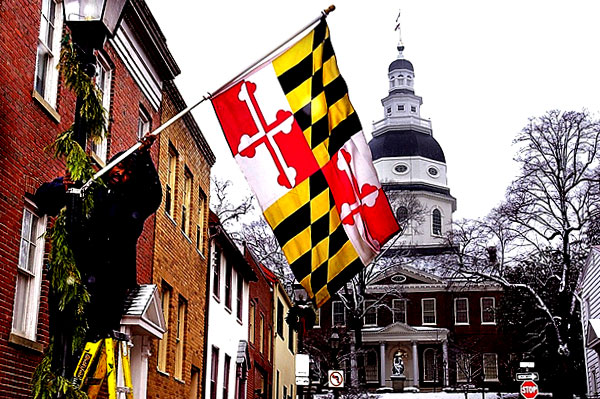
The Maryland state flag stands out from the rest, a striking patchwork of gold, black, red, and white. It’s bold, it’s regal, and it’s everywhere in the state: from front porches in Annapolis to Ravens jerseys in Baltimore.
But this flag isn’t just eye-catching, it’s a living symbol of a state torn in two.
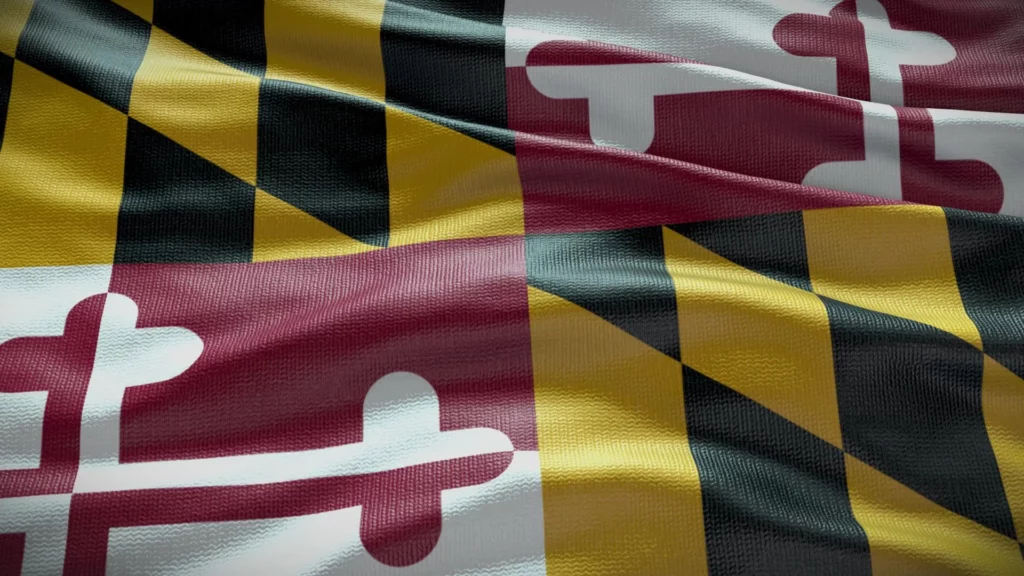
During the Civil War, Maryland was caught between the Union and the Confederacy. Families were divided, neighbors chose opposite sides, and the state became a tense, conflicted crossroads in a nation at war with itself. And out of that painful chapter of American history came something truly remarkable: a flag that stitched together two opposing identities into one unified emblem.
The Colonial Roots: Lord Baltimore’s Legacy
Before it became a symbol of Civil War reconciliation, the Maryland flag had its origins in the aristocratic arms of two powerful English families, both connected to the man who founded Maryland.
🏰 Who Was Lord Baltimore?
In 1632, George Calvert, the first Lord Baltimore, was granted a charter by King Charles I to establish a new colony in America. His vision was to create a haven for English Catholics facing persecution at home, and that colony would become Maryland.
But with Lord Baltimore came something just as enduring as the colony itself: his family coat of arms.
Two Families, Two Symbols
The Maryland flag is a perfect fusion of the coats of arms from two noble English families:
Family NameRelation to George CalvertColors & DesignUsed by…CalvertPaternal (Father’s side)Black and gold with a unique chevron patternMaryland colonial government, Union supportersCrosslandMaternal (Mother’s side)Red and white with a cross bottonyConfederate sympathizers in Maryland
⚫🟡 The Calvert Arms: Symbols of Authority
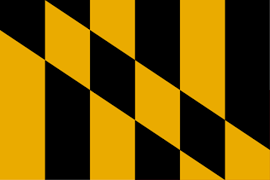
The black and gold pattern (officially called “paly of six Or and Sable, a bend counterchanged”) was used throughout colonial Maryland to represent the authority of the Calvert family as proprietors of the colony.
You would have seen the Calvert arms:
On the original Great Seal of Maryland
Above government buildings and military standards
Engraved on colonial currency and legal documents
These colors represented:
Strength and sovereignty
The legitimate rule of Lord Baltimore
Maryland’s identity as a proprietary colony under English law
🔴⚪ The Crossland Arms: A Hidden Legacy
The red and white Crossland cross bottony (a cross with trefoil tips) was lesser known during the colonial era. It wasn’t used by the Maryland government but remained part of George Calvert’s maternal heritage.
It wasn’t until the Civil War, over 200 years later, that this symbol would emerge in full force, embraced by Marylanders who sided with the Confederacy.
🧬 Why These Arms Matter
Together, the Calvert and Crossland arms represent two halves of one lineage, and later, two sides of a divided state. The fusion of these coats of arms into one flag wouldn’t happen until long after the colony was founded, but the symbolism was always there, waiting to be rediscovered.
Maryland During the Civil War: A House Divided
⚔️ Torn Between Two Sides
When the Civil War broke out in 1861, Maryland was a border state with loyalties split right down the middle. Though it never seceded from the Union, the state was home to both passionate Unionists and fierce Confederate sympathizers.
This internal conflict played out in its towns, its legislature, even within individual families.
🇺🇸 Why Maryland Stayed in the Union
Maryland’s location was strategically vital to the Union. It surrounded Washington, D.C., and had critical railroads and shipping routes. If Maryland joined the Confederacy, the U.S. capital would be completely cut off.
President Abraham Lincoln took extraordinary measures to keep the state loyal:
Suspended habeas corpus in Maryland (allowing arrest without trial)
Jailed pro-secession lawmakers before they could vote on secession
Stationed federal troops throughout Baltimore and other key cities
💥 The Baltimore Riot of 1861
One of the earliest and bloodiest signs of division was the Baltimore Riot on April 19, 1861, where Union troops moving through the city were attacked by pro-Confederate civilians. This event shocked the nation and proved just how divided Maryland truly was.
🧍♂️🧍♀️ Marylanders on Both Sides
Tens of thousands of Marylanders fought in the war, for both sides:
AllegianceEstimated Maryland TroopsNotable RegimentsUnion60,000+1st Maryland Infantry (Union), Maryland VolunteersConfederacy20,000+1st Maryland Infantry (CSA), Maryland Line
Families often had sons, fathers, and brothers fighting on opposite sides of the conflict, a painful reality that tore communities apart.
🏴 The Flags of Division
As Marylanders chose sides, they adopted different heraldic symbols to represent their allegiance, both drawn from George Calvert’s family heritage.
Union Supporters: Calvert Colors (Black & Gold)
Symbolized loyalty to the original colony and the Union
Used on flags, military insignia, and government emblems
Seen as a symbol of order and law
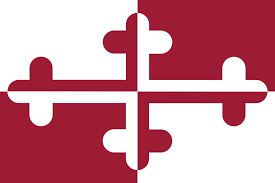
Confederate Supporters: Crossland Banner (Red & White Cross)
Based on Calvert’s maternal family arms
Adopted as a symbol of rebellion and southern identity
Often flown in southern-leaning areas of Maryland
🔀 A State Split in Symbols
Maryland was one of the only places where two heraldic banners from the same family became symbols for opposing factions in the same war.
This unique use of symbolism laid the foundation for the modern Maryland flag, which would later reunite the two designs, not to show division, but to heal from it.
Rebuilding After the War: A Symbol of Healing
🤝 The Need for Reconciliation
After the Civil War ended in 1865, Maryland faced a deep emotional and political wound. Though it had remained in the Union, it was home to many who had fought, and died, for the Confederacy. The war didn’t just divide the country; it divided towns, churches, and families in Maryland.
The state needed a way to acknowledge its fractured past without reopening old wounds, and that’s where the symbolism of the two family crests began to take on new meaning.
🏁 A Flag Reimagined
In the decades following the war, Marylanders began informally combining the black-and-gold Calvert banner and the red-and-white Crossland cross. This merging wasn’t mandated by law, it grew organically out of:
Parade flags at post-war commemorations
Militia regalia that honored both Union and Confederate veterans
Public monuments dedicated to both sides of the conflict
State events seeking unity in symbolism
This hybrid flag became a grassroots emblem of healing, representing both sides of the war and the shared identity of Marylanders, regardless of their Civil War allegiance.
🪖 Case Study: The Fifth Regiment
One of the earliest and most visible uses of the combined banner came from the Fifth Regiment of the Maryland National Guard, which had roots in both Union and Confederate military units.
By 1880, the regiment began displaying flags that featured both Calvert and Crossland patterns
These designs became especially prominent at veteran reunions and Memorial Day events
Soldiers wearing these banners were seen as walking symbols of unity, not division
🗓️ Timeline: From Civil War to Official Flag
YearEvent1865Civil War ends; Maryland begins to wrestle with internal reconciliation1870s–1880sCombined Calvert-Crossland designs gain popularity at local events1888Fifth Regiment prominently uses the dual-symbol flag1904Maryland General Assembly officially adopts the current flag as the state flag
📜 1904: The Flag Becomes Official
The Maryland General Assembly passed a law in 1904 declaring the current flag, featuring all four quarters of the Calvert and Crossland arms, as the official state flag of Maryland.
It was more than a design choice. It was a deliberate message:
“We remember where we came from. We acknowledge our divisions. But we stand united.”
This made Maryland’s flag the only U.S. state flag to directly reflect the legacy of both Union and Confederate symbolism, woven together in peace.
Official Adoption: From Grassroots Symbol to State Flag
🧩 A Flag That Already Belonged to the People
By the turn of the 20th century, Marylanders had already embraced the combined Calvert and Crossland design. It appeared:
At public buildings and government functions
On military uniforms, especially within the Maryland National Guard
In parades and post-war commemorations
As part of civic pride in cities like Baltimore and Annapolis
Though still unofficial, the design had become widely understood as “the Maryland flag.”
🏛️ 1904: The Legislature Makes It Official
On March 9, 1904, the Maryland General Assembly passed a bill that formally established the design as the official state flag.
📜 The Law’s Language
The act didn’t invent the flag, it recognized what the people had already adopted:
“The State Flag is described as consisting of the heraldic banner of George Calvert, first Lord Baltimore… and that of the Crossland family, thus combining the arms of both paternal and maternal lineage.”
This legislative act codified the symbolism as a state-sanctioned gesture of unity, making Maryland the first and only U.S. state to use a true heraldic flag with such direct links to colonial nobility and Civil War reconciliation.
🧠 Why It’s Unique Among U.S. State Flags
Most state flags follow a simple template: a blue field with a seal in the center. Maryland’s is entirely different, and proudly so.
AspectMaryland FlagMost State FlagsOriginBased on family coats of armsDesigned post-statehood or post-Civil WarSymbolismUnion + Confederate unityOften generic or only loosely symbolicDesign StyleMedieval heraldry (Calvert + Crossland)State seal on a plain backgroundColorsBright, bold, non-standardPredominantly blue with state emblemsAdoptionOfficially in 1904 after grassroots useMany adopted late 1800s–early 1900s
🧭 A Symbol That Reflects Maryland’s Complexity
In adopting the flag, Maryland wasn’t just choosing a visually interesting design. It was making a statement:
That history isn’t always clean or one-sided
That symbolism can evolve from division to unity
That heritage and reconciliation can coexist
To this day, the flag stands as a rare example of political and cultural healing, honoring both Maryland’s colonial roots and its turbulent role in America’s most painful conflict.
Design Breakdown: What Each Quarter Means
At first glance, the Maryland flag might look like an abstract patchwork of color, but every shape, color, and angle carries specific meaning drawn from medieval heraldry.
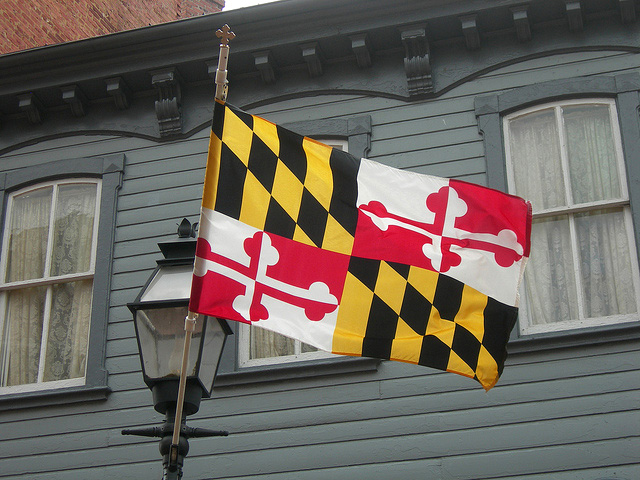
The flag is divided into four quarters, alternating between the Calvert and Crossland family arms. Here’s what each section represents:
🟦 The Four Quarters Explained
QuarterDesignSymbolizesOriginTop LeftGold and black vertical bars with diagonal chevronsStrength, leadership, proprietary authorityCalvert (paternal)Top RightRed and white cross bottonyCourage, honor, noble serviceCrossland (maternal)Bottom LeftRed and white cross bottonySame as above (mirrored placement)Crossland (maternal)Bottom RightGold and black vertical bars with diagonal chevronsSame as above (mirrored placement)Calvert (paternal)
⚫🟡 The Calvert Arms (Black and Gold)
Colors: Black and gold (technically sable and or)
Pattern: Six vertical stripes crossed by a diagonal band that flips the color scheme
Interpretation:
The chevron is often seen in heraldry as a symbol of military strength and construction
The color gold (or) symbolizes generosity and elevation of the mind
Black (sable) traditionally represents constancy
Calvert’s arms were a visible expression of his power as the first Lord Proprietor of Maryland, and these symbols were used throughout colonial Maryland in official capacities.
🔴⚪ The Crossland Arms (Red and White)
Colors: Red and white (technically gules and argent)
Design: A cross bottony, a cross with trefoil (clover-shaped) ends
Interpretation:
The cross symbolized Christian faith and noble service
The bottony shape indicates a flowering or blossoming, suggesting hope or regeneration
Red (gules) denotes warrior spirit, courage, and valor
White (argent) means peace and sincerity
Though the Crossland arms were not used by the government in colonial times, they were embraced by Confederate Marylanders during the Civil War, later becoming part of a symbol of unity and reconciliation.
🧩 Why This Matters
Every element of the flag is deliberate. Together, these symbols:
Represent both sides of George Calvert’s family tree
Tell the story of a state with dual identities during the Civil War
Form one cohesive flag to symbolize unity, strength, and shared heritage
Unlike many state flags that use generic symbols or seals, the Maryland flag visually communicates the state’s history and values, past and present, in a way that’s bold, unique, and deeply personal.
Legacy and Cultural Pride
🎉 A Symbol Marylanders Wear Proudly
The Maryland flag isn’t just something you see at government buildings, it’s a powerful source of pride woven deeply into everyday life across the state.
From sports to fashion to local celebrations, the flag is everywhere, and Marylanders love it.
🏈 Sports and the Maryland Flag
Baltimore Ravens: The NFL team’s alternate uniforms and fan gear often feature the flag’s iconic pattern.
University of Maryland Terrapins: Their athletics program prominently incorporates the flag’s colors and design into their uniforms and logos.
Local high schools and youth sports teams also proudly sport the colors, reinforcing community ties.
👕 Fashion and Pop Culture
Apparel companies produce Maryland-themed clothing, hats, and accessories that highlight the flag’s bold patterns.
Local artists and designers use the flag in murals, street art, and crafts, making it a vibrant symbol of identity and creativity.
It’s common to see the flag flying from front porches, painted on boats, or even tattooed as a mark of state pride.
📅 Annual Events and Celebrations
Maryland Day (March 25): The flag is prominently displayed during events celebrating the state’s founding.
Civil War reenactments and historical commemorations often use the flag to honor Maryland’s unique role and legacy.
Community parades, festivals, and government ceremonies fly the flag as a unifying symbol.
🏅 Why Marylanders Love Their Flag
ReasonExplanationUnique DesignStands out among all U.S. state flagsHistorical DepthConnects the state’s colonial roots and Civil War pastSymbol of UnityRepresents reconciliation and shared identityBold Colors and PatternsVisually striking and easily recognizableCultural VersatilityUsed in sports, fashion, art, and civic pride
🌟 The Maryland Flag: A Living Legacy
The flag’s blend of history and modern culture shows how symbols evolve but stay meaningful.
It reminds Marylanders that while the state has a complex past, there’s strength in unity and pride in heritage, all captured in a design that’s as vibrant today as it was centuries ago.
Conclusion: A Flag That Tells a Story
The Maryland state flag is far more than just a piece of fabric waving in the wind. It’s a powerful emblem steeped in history, woven from the threads of family legacy, war, division, and reconciliation.
Born from the heraldic arms of George Calvert’s two families, it became a symbol of a state divided during the Civil War, and then a banner of unity in the difficult years that followed. Today, it stands as a reminder that:
History is complex and sometimes painful, but it can also inspire healing and hope.
Symbols hold the power to divide and unite, and Maryland’s flag beautifully captures both realities.
Pride in heritage can embrace all sides of a story, acknowledging the past while moving forward together.
So the next time you see Maryland’s striking black, gold, red, and white flag, remember, you’re not just looking at colors and patterns. You’re witnessing the story of a state that, through conflict and courage, found a way to fly united under one banner.